
Reviewed and updated August 2026
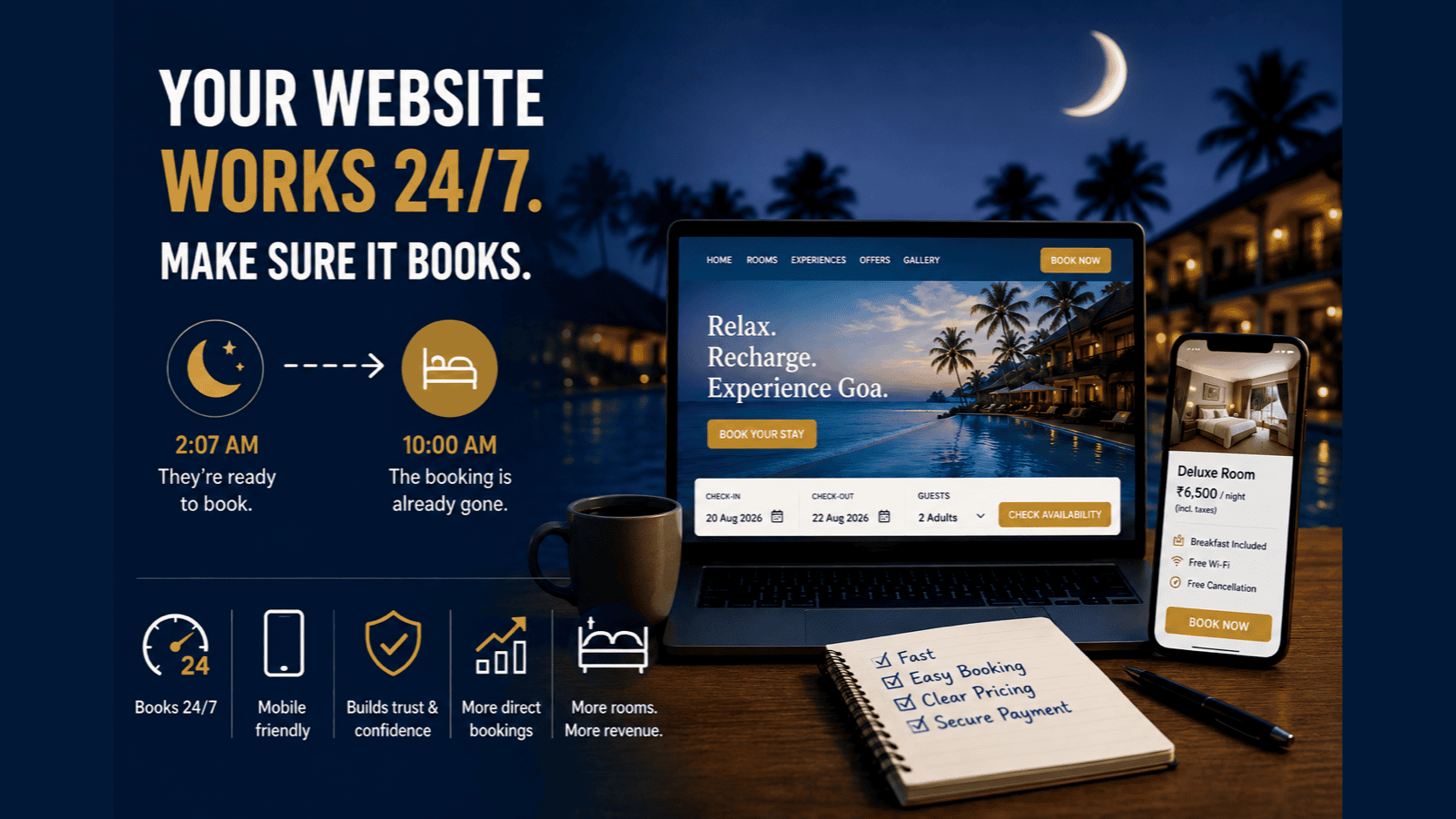
It's 2:07 AM.
Someone in Bengaluru can't sleep and starts planning a spontaneous Goa getaway. Another traveller has just found cheap flights from Delhi for the upcoming long weekend. A couple in Pune is comparing resorts after watching one too many Instagram Reels of sunset cocktails, colourful Fontainhas streets and swaying coconut trees.
They land on your website. They like your property. They want to book. But the room rates aren't visible.
Instead of letting them book, the enquiry form asks them to “wait for confirmation.” The booking button doesn't work properly on mobile, or worse... there isn't one. So they do what most modern travellers would do.
They open Booking.com or another OTA and reserve a similar resort in under two minutes. By the time you unlock your office the next morning, that booking and the revenue have already gone somewhere else. The reality is simple.
Your website isn't just an online brochure anymore. It's often your most important salesperson. And unlike the rest of us, it doesn't need coffee to work the night shift.
Travel planning today often begins long before someone reaches a booking website. According to Google-commissioned Kantar research, 85% of surveyed Indian travellers said they prefer booking their trips online. 1 By the time someone lands on your website, they're often already convinced about the destination. Your website's job isn't only to inspire them; it must also make booking as simple as possible.
Today's guests book when it's convenient for them
Guest behaviour has changed dramatically over the last few years. People don't just book holidays during office hours anymore. They browse while commuting, during lunch breaks, while binge-watching Netflix and yes... at 2 AM when sleep has officially given up on them.
Recent travel trends support this shift. Scapia's Summer Travel Trends 2026, based on bookings made through its own platform, found that more than one in three domestic flight bookings were made within three days of departure. 2
While the research relates specifically to flights rather than hotel reservations, it reflects a growing preference for shorter planning windows. Combined with Google's findings that Indian travellers increasingly research and book online, it reinforces the need for hotel websites that make booking fast and effortless.
With travellers increasingly researching trips through digital and mobile channels, a seamless mobile experience has become essential. 1
If your website can't accept a booking instantly, you're asking guests to come back later. Many won't. Convenience often wins.
Direct hotel bookings should feel effortless
Think about the last time you bought something online. You probably didn't want to send an inquiry and wait for someone to call you back.
You wanted to know:
- Is it available?
- How much does it cost?
- Can I book it now?
Hotel guests are no different. A modern hotel website should answer those questions within seconds. The easier the experience, the greater the chance of converting a visitor into a direct booking and every direct booking matters. Not only can it reduce OTA commission costs, but it also gives your resort greater control over guest communication, loyalty and future marketing.
A beautiful website isn't enough
Many independent resorts invest in stunning photography, drone shots, infinity pools, golden-hour beach walks and a friendly dog named Bruno casually wandering through the property. All wonderful.
But beautiful images don't automatically generate bookings. Your website also needs to do its job.
- Can guests check availability instantly? Is pricing transparent? Is your booking engine connected to real-time inventory?
- Are rates, inclusions and taxes equally clear on desktop and mobile?
- Does the booking journey work smoothly on a mobile phone?
- Can someone complete a reservation in under three minutes?
Because if they can't...
Your website isn't selling.
It's sightseeing.
Your booking engine is part of the guest experience
A booking engine isn't just another piece of software. It's the bridge between interest and revenue.
Every extra click, every confusing form, every unnecessary step. Each one gives guests another reason to leave.
- Can guests compare room types without opening multiple tabs?
- Can they change their travel dates without starting the booking all over again?
- Can they apply a promo code easily?
- Can they complete payment without wondering whether the transaction is secure?
The best booking journeys are almost invisible.
Guests shouldn't have to think about how to book. They should simply... book.
A Good Website Should Be Measured, Not Just Admired
A beautiful website doesn't always translate into more direct bookings. The real question isn't whether your website looks impressive, it's whether it quietly converts visitors into paying guests.
The most successful independent resorts don't just monitor website traffic. They pay attention to what happens after a guest arrives.
Ask yourself:
- How many website visitors actually start a booking?
- Where are guests abandoning the booking journey?
- Do mobile users complete reservations as often as desktop users?
- How many bookings come directly through your website compared to OTAs?
These numbers tell a far more valuable story than page views alone.
Sometimes a small improvement such as simplifying a payment page, reducing unnecessary booking steps or improving mobile usability can recover bookings that would otherwise have been lost.
Because when you measure the booking journey, you stop guessing where revenue is slipping away.
Fast websites win more bookings
We've all done it. A website takes too long to load. You stare at the spinning circle.
Wait a few seconds. Then quietly close the tab.
Your guests do exactly the same.
A Deloitte Digital study commissioned by Google analysed more than 30 million mobile sessions and found that, for travel websites, a 0.1-second improvement in mobile speed was associated with a 10.1% increase in conversion rates. 3
Website speed matters because travellers compare multiple resorts during the same browsing session.
The exact improvement will vary by website, but the direction is clear: faster booking journeys give guests fewer reasons to leave.
Google recommends meeting Core Web Vitals thresholds to improve user experience. While they are one of many ranking signals, poor page experience can reduce competitiveness when content quality is otherwise similar. 4
Trust sells rooms
Imagine finding two similar resorts.
One has:
- Recent photographs
- Updated room descriptions
- Clear cancellation policies
- Secure online booking
The other has:
- Photos from 2019
- Broken links
- An enquiry form
- No visible reviews
- An outdated website
Which one would you trust with your holiday? Exactly.
Guests don't always book the cheapest option. They often choose the resort that feels safest, easiest and most professional.
Your website and OTAs should work together
This isn't about declaring war on OTAs. They're valuable partners.
They introduce thousands of travellers to independent resorts every day.
The goal is balance.
If someone already knows your resort, visits your website and still books through an OTA because it's easier, that's a missed opportunity.
A good booking engine, accurate inventory, transparent pricing and sensible rate parity help ensure your own website becomes the easiest place to complete a reservation.
Five questions every resort owner should ask
Take two minutes. Open your own website.
Now imagine you're a guest visiting for the first time.
Can you answer “Yes” to every question?
- Can I see room availability immediately?
- Can I understand pricing without submitting an enquiry?
- Can I complete a booking from my phone?
- Does the website load quickly?
- Would I confidently enter my payment details here?
If you hesitated even once, there's probably revenue quietly slipping through the cracks.
Your Website Never Sleeps
Unlike your reservations team, your website works every hour of every day. It doesn't take weekends off, it doesn't celebrate public holidays and thankfully, it doesn't complain when another long weekend sends enquiries through the roof.
Whether someone books at 10 AM or 2 AM shouldn't matter.
The experience should be exactly the same: simple, fast and reassuring.
As we say in Goa, everything should feel a little more susegad, effortless and enjoyable because every time someone is ready to book your resort, your website should be ready.
If it can do that, you'll win more direct bookings and probably sleep a little better yourself.
Is your website quietly losing bookings?
When was the last time you tried booking a room on your own website as if you were a guest? If it's been a while, today might be the perfect day to give it a go.
You may be surprised by what you discover.
At Hotel Growth Partners, we review the complete direct-booking journey from room visibility and pricing to booking-engine usability, payment flow and distribution strategy. Whether your resort already has systems in place or you're starting from scratch, we can design, implement and manage the complete commercial technology stack, including your website, booking engine, PMS, payment gateway, channel manager and OTA distribution. If guests are reaching your website but not completing their reservations, we'll help identify where the journey is breaking down and put the right solution in place.
Footnotes
1 Google & Kantar Travel Rewired: Decoding the Indian Traveller
2 Scapia India Enters the Micro Holiday Economy
3 Google + Deloitte Digital Milliseconds Make Millions
4 Google Search Central Core Web Vitals